These records are found in the online catalog of The Mariners’ Museum and Park in Newport News, Virginia. Uncurated search results are presented to give researchers and interested readers an idea of whether the museum’s archives contain information about this vessel and whether it may be worthwhile to visit the museum’s catalog search page for further investigation. Uncurated results may be inaccurate or incomplete.
Mariners Museum online catalog search, July 12, 2026. Search phrase: "Rover". Catalog returned 41 records; this selection table includes 41 records fetched through catalog result pages.
Use these buttons to send uncurated search results to your own app or text document for further research. First, check the box for any row, or click "Select All" then uncheck any rows. Then click "Show Selections". You can then copy your selections from the text box and past them into your app.
Fetch?
Row ID
Media
Date
Vessel
Place
Related Places
Inscription/Marks
Subject
Notes
Archive Number
1
Conrad, Joseph, 1857-1924. Works. Kent ed. ; v. 24.
Maps on lining papers. "Thomas H. Raddall ... delved into the ancient records and wrote the story in prose and rhyme. Thomas W. Hayhurst ... drew the illustrations and designed the cover. Col. C.H.L. Jones' ... suggestions and criticisms gave it shape..."
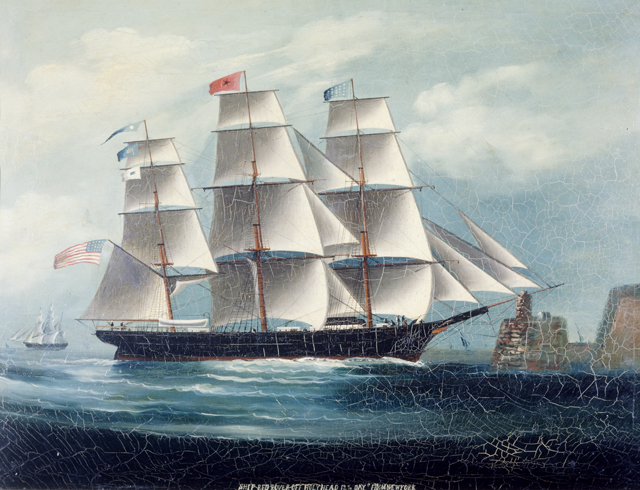
NOTES: Sam Davidson 9/22/95 typical Chinese , starboard windward view, flat hull, crackelure, US flag, Marryat 2/81 at mizzen correct, House flag, Black Star red ground, Pilot jack. Holyhead on right is very naïve and at improbable angle- (Ray Brighton Clippers of the port of Portsmouth) using voyage notes hard to say which voyage ?5th ** NOTES: The Red Rover was also known as Young Australia.
Steamboats–United States.; Paddle steamers–United States.
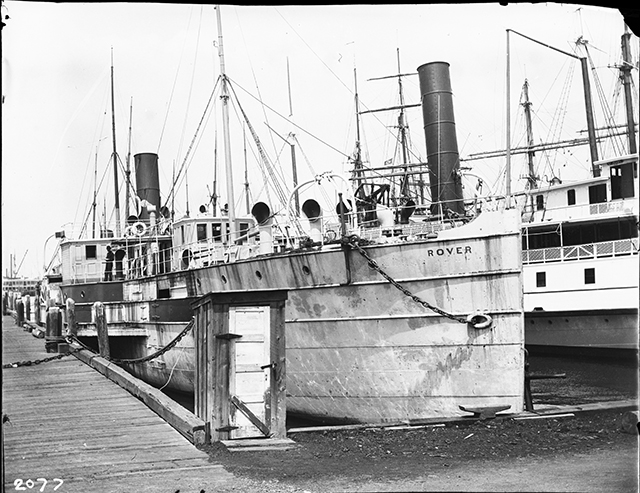
Shows a starboard side view of the bow of a side wheel steamer moored at a pier. Stanton's notebooks contain the following information about this item: "May 6 96"
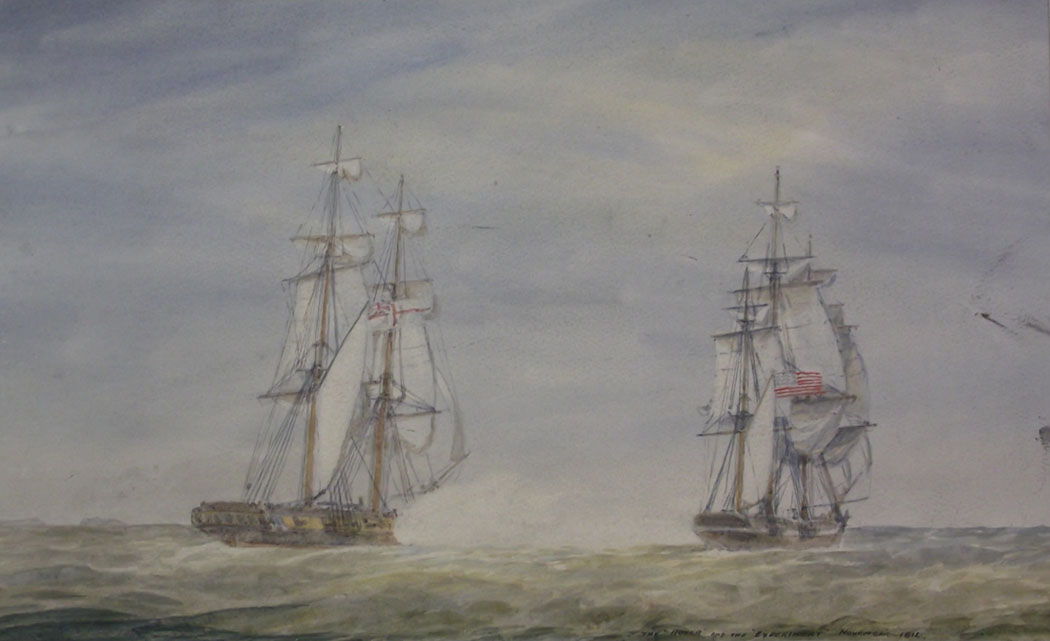
NOTES: Information concerning the Bailey Collection of watercolor views of U.S. Naval actions (1745-1850) in The Mariners’ Museum, Newport News, Virginia In 1940 The Mariners’ purchased from a dealer in London a collection of 254 watercolor drawings, which were at the time attributed to Charles T. Warren (1767-1823), an engraver. They were represented as having belonged to a Charles Kingsley Bailey, and have henceforth been referred to as the Bailey Collection. The views in the collection range from the Siege of Louisburg in 1745 to an action which occurred in 1850. Simply on the basis of the breadth of coverage, then, it appeared unlikely that these were executed contemporary to the action by one person. Moreover, persons making studies of individual vessels represented in the collection have pointed out that there are major inaccuracies in the details of the vessels. Research initiated by the museum from 1974 to 1982 subsequently revealed that the watercolors were actually done by Irwin John Bevan (1852-1940). Welsh-born Bevan was a keen naval historian and his sketches and paintings included many maritime subjects. His work can be seen in Sea Fights of the Great War by W.L. Wyllie and M. F. Wrenn, published in 1918. Since Bevan did book illustrations, the present assumption is that this group of watercolors was executed to illustrate a projected work on the history of the U.S. Navy, especially as it related to the British Navy. Detailed contemporary accounts of the U.S.-British actions were written down in letters, official reports and newspapers of the day and nineteenth century historians had these sources available for their texts. The accounts accompanying Bevan’s paintings relied heavily on all these sources. Notwithstanding this however, the paintings must not be taken as primary documents of either the vessels or the engagements. They should be viewed in the context of the artist’s conceptions, which may vary considerably in their reliability. It is left to the discretion of the researcher whether or not this material will be of value in the current project.
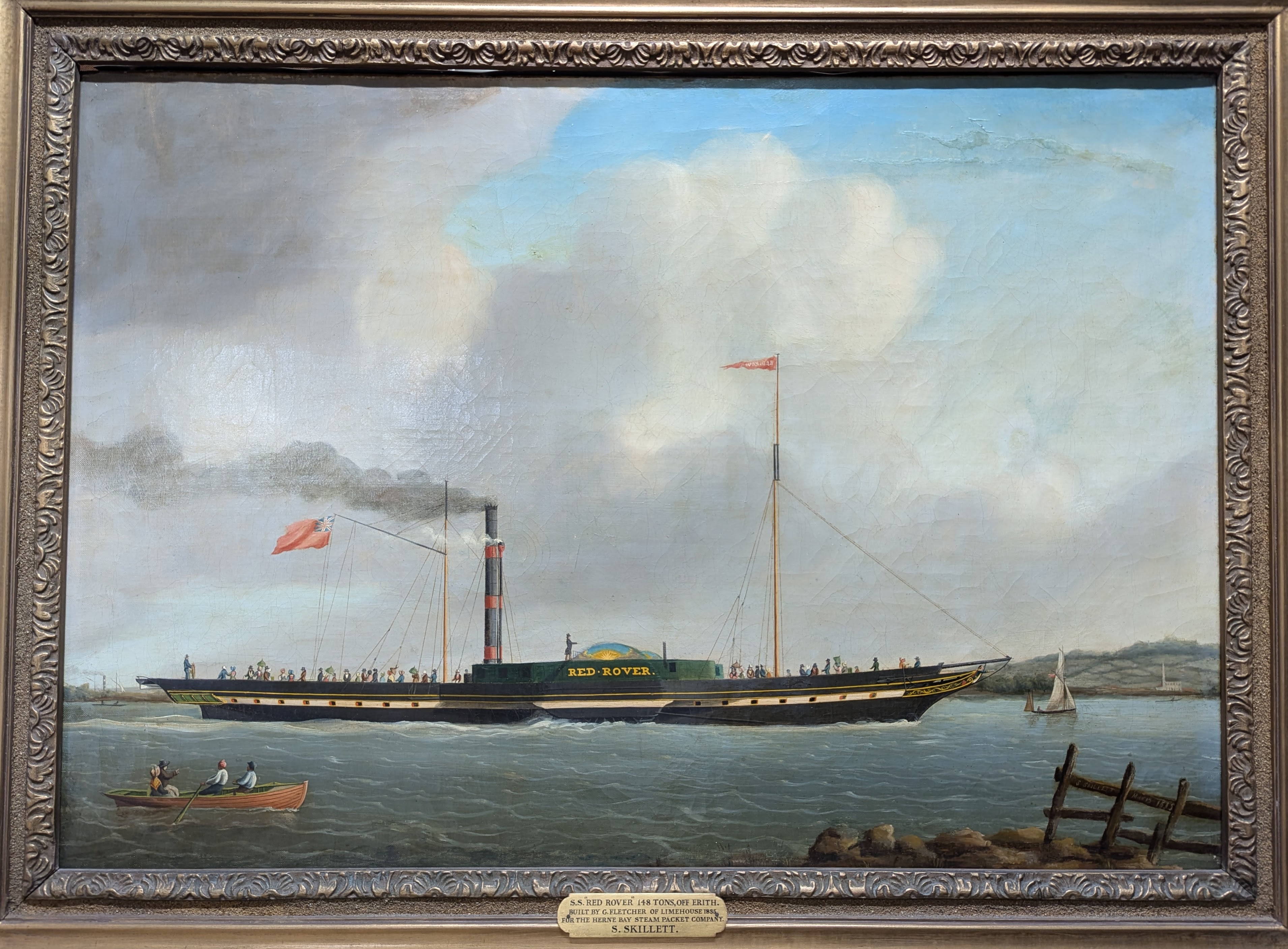
NOTES: Sam Davidson 9/22/95, Skillett, very nice May? 1835. Lovely, owner, Herne Bay Steam Packet Company. Fascinating note about this painting being commissioned by Thomas Brocklebank (presumably the Thomas Brocklebank, shipowner of Liverpool, see your JAMAICA)*** VESSEL INFORMATION - VESSEL NAME: RED ROVER VESSEL TYPE: SIDE-WHEEL SCHOONER, BRITISH VESSEL BUILT: 1835 SHIPBUILDER: G. FLETCHER BUILDER LOCATION: LIMEHOUSE, LONDON, ENGLAND SHIP OWNERS: HERNE BAY STEAM PACKET COMPANY
Reproduced from typescript. "A research paper submitted to the head of the Department of English, History, and Government, U.S. Naval Academy, Annapolis, Maryland, February, 1960" T.p.
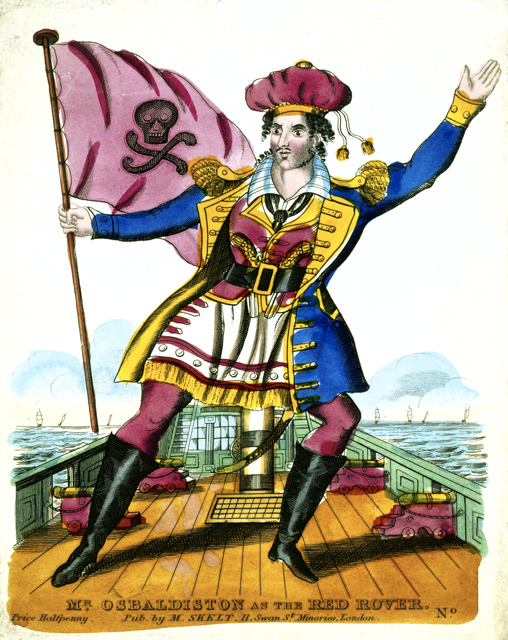
11 SWAN STREET, MINORIES - LONDON - ENGLAND - Publisher
SHORT DESCRIPTION: Hand-colored engraving titled “Mr. Osbaldiston as the Red Rover” published by M. Skelt at 11 Swan Street, Minories in London. The image is a theatrical portrait of the actor David Webster Osbaldiston playing the lead role in ‘The Red Rover.’ These images were printed and sold as plain or colored theatrical souvenirs. This sheet is one of Skelt’s cheaper halfpenny sheets and was probably sold uncolored. The coloring was added later by the purchaser or another person. The bright watercoloring is rather poor, frequently crossing over the engraved lines, although the coloring does appear to be higher quality than other examples. The engraving dates between 1828 and 1833 (see note below). The image shows the actor in a dramatic pose standing on the deck of a ship. His body is facing the viewer but his head and eyes are turned slightly left. His left arm is raised over his head and his hand is open. His right arm is raised to shoulder height and his right hand holds the staff of a fluttering maroon flag featuring a black skull and crossbones. His legs are splayed wide, his body leans to the right with left knee bent and turned to the side while his right leg is straight with the foot pointed to the bottom left corner. The actor wears a large, poofy maroon hat adorned with two gold tassels and a tight gold-colored brim. He wears a long royal blue coat with gold fringed epaulettes, gold-colored lapels and lining and gold lace running to gold buttons. His left cuff is gold but the right is blue. He wears a maroon vest with gold-colored lapels and gold-colored lace lining the front edges and bottom. A white striped shirt with a large collar is underneath. The actor wears a long black loose necktie tied in a knot and tucked into the top of the vest. At the actor’s waist is a wide black belt with a gold belt buckle. The belt sits over the vest and has two gold handled pistols tucked behind it. He wears a skirt ornamented with short maroon stripes at the left side and two maroon stripes running around the bottom above a layer of gold-colored fringe with a row of white buttons between them. The actor wears maroon-colored leggings and knee high black boots. The actor is posing on the deck at the stern of a ship. Four cannons on carriages, a deck grating, the base of a mast, a cabin with glass windows, and two ladders leading up to an unseen poop deck are behind him to the right, center and left. In the background to the right and left is water with multiple ships under sail on the horizon and distant low clouds. NOTES: ‘The Red Rover’ was a novel by American writer James Fenimore Cooper. It was originally published in Paris on November 27, 1827, in London on November 30, 1827 and in Philadelphia in the United States on January 9, 1828. Soon after its publication it was adapted for theater in the United States and England. The story follows the characters of sailor Dick Fid, a free black sailor named Scipio Africanus and Royal Navy officer James Wilder as they encounter the famous pirate, the Red Rover. Four adaptations of ‘The Red Rover’ were created and performed in England starting in 1828 and 1829. The theaters were the Royal Cobourg Theatre, Adelphi Theatre in London, the Surrey Theatre and the Sadler’s Wells Theatre. According to John D. Gordon in the article "The Red Rover Takes the Boards" published in American Literature, Vol. 10, No. 1 (Mar., 1938), pp. 66-75 (10 pages) David Webster Osbaldiston performed in The Red Rover on September 7, 1829 at the Surrey Theater in London. A Surrey playbill for September 9, 1828, preserved in the Widener Library, shows that Osbaldiston played the Rover and T.P. Cooke played Fid. Newspaper articles show the play was continuously performed at the Surrey Theatre from September 1829 through October 1833 with Osbaldiston playing the lead. David Osbaldiston was the proprietor of the Surrey Theater in 1833. NOTES: Excerpts taken from ‘Juvenile Drama’ by George Speaight (published by Macdonald & Co, Ltd., London, 1946) In the late 18th and early 19th century theatrical prints were introduced to the British public. Caricaturists drew portraits of actors and actresses in dramatic positions “with arms akimbo,” shaking their fists, stamping their feet. The impression of the actor on the stage is “re-inforced by the lay out of the prints themselves; the characters seem to be placed in one plane, and there is even a tendency to see them in profile.” They are usually presented in rich, vivid, flat color. They were intended to present a dramatic feeling or theatrical design. In the 1830’s prints were developed for the “Toy Theatre,” a cheaper version of the prints made for Juvenile Drama plays in the 1810s and 1820s. According to Speaight, the prints made for the Toy Theatre were “standardized, the printing less careful, the paper cheaper, and the colouring much cruder.” Among the names associated with the popularization of the Toy Theatre was Martin Skelt who was a shoemaker in the Minories who may have displayed Juvenile Drama sheets in his window “as the agent for the various publishers.” According to Speaight “sometime early in the 1830’s he began to buy up the stocks and copper plates of publishers who were closing down, substituting his own name, and re-issuing them…and maintained the original price of a penny.” He then started publishing on his own account and did a few plays of his own before turning to a cheaper type of halfpenny sheet. He published about fifty plays in this style. In the business with Skelt at various points throughout his operation were his brothers Martin, Matthew, Benjamin and Ebenezer. The brothers did their best to buy out every other publisher and get all the plays into their hands. The Skelt brothers issued no less than five different versions of the Toy Theatre favorite ‘The Miller and his Men’ and two versions of nearly a dozen other plays. Where they excelled was in the distribution of thousands of sheets, many colored by hand and sold at newsagents and stationers all over Great Britain. The plays were published at the rate of one large sheet each week which contained four small quarto plates, and had to be cut up by the retailer.” In 1884, Robert Louis Stevenson, who apparently grew up “viewing these images of gesticulating villains, epileptic combats, bosky forests, palaces and warships, frowning fortresses and prison vaults,” wrote an essay about the Toy Theatre in which he coined the phrase “Penny Plain and Twopence Coloured” and stated that “the name of Skelt itself has always seemed a part and parcel of the charm of his productions…Indeed, this name... appears so stagy and piratic, that I will adopt it boldly to design these qualities.” Speaight also states “As a publisher, the Skelts cannot compare with West and the Hodgsons. Their plays are mostly old favourites and little different to those of their contemporaries in style; by the fact that they republished a great many sheets from older smaller firms, they act as a link with an earlier period, and the volume of their work entitles them to a major place in any Toy Theatre history; but, as publishers, that is all one would say. They should, however, be given pride of place as popularisers of the Toy Theatre; it was due to their energy and business skill that Toy Theatre plays went into almost every middle class home in the kingdom, that innumerable Theatres Royal Front Drawing Room witnessed innumerable thrilling dramas and bloody combats, that red fire was burnt and crackers pulled in innumerable grand explosions. “ Skeltery ” was enshrined in the homes of England.” Speaight continues “Any serious historian of the Juvenile Drama feels obliged to depose Skelt from the high place to which a literary allusion has thrust him, but we must not fall into the opposite error of disparaging his work; he was not the first or the greatest publisher, but his plays are amazingly good for the price at which they were sold, and his influence was enormous; we need not grudge him his niche of glory.” The 1840s appears to have been the Skelt’s heyday, but the business lingered into the 1860s. “When the Skelt business was finally given up a number of their plates passed to a publisher named W. G. Webb in Old Street…but most of these plates were broken up or entirely destroyed by rust.” Speaight dates the Skelt operation to 1835-1872 and puts their locations as 11 Swan Street and 17 Swan Street in Minories. ‘The Red Rover’ was a play in a halfpenny sheet.
NOTES: LP 200- LP 225 are part of a set of lithographs in colors on wove paper by Frederic Schiller Cozzens (American, 1846-1928). ADDITIONAL INFORMATION: See Kelley, J.D.Jerrold, "American Yachts", Chapter l and pg. 422. See also "The Old Print Shop Portfolio", Vol. I, No. 9, May 1942.
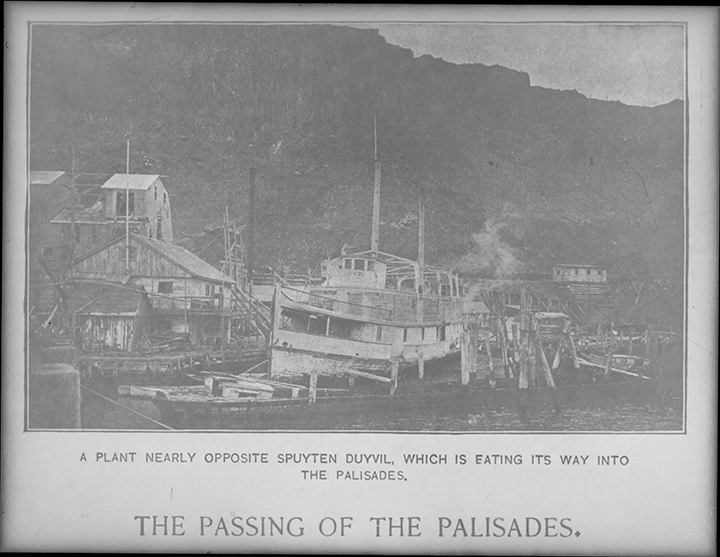
Hudson River (N.Y. and N.J.).; Palisades (N.J. and N.Y.).
At Palisdades opposite Spuyten Duyvil Paper Negative Dismantled Hudson River Freight Streamer or Barge
A photograph of an unidentified Hudson River Freight Steamer or Barge being dismantled. The location is on the west bank of the Hudson River, across from the mouth of Spuyten Duyvil Creek
NOTES: LP 200- LP 225 are part of a set of lithographs in colors on wove paper by Frederic Schiller Cozzens (American, 1846-1928). ADDITIONAL INFORMATION: See Kelley, J.D.Jerrold, "American Yachts", Chapter l and pg. 422. See also "The Old Print Shop Portfolio", Vol. I, No. 9, May 1942.
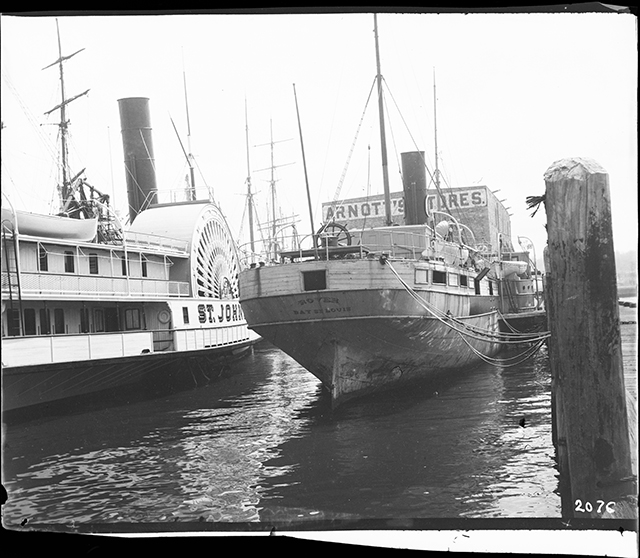
ST. JOHNS (SIDE-WHEEL SCHOONER: 1878-1927) - ROVER (SIDEWHEEL STEAMBOAT: 1881)
Rover; 2076
Steamboats–United States.; Paddle steamers–United States.
Shows a nearly head on view of the stern of a paddle steamer moored at a pier. One side of another paddle steamer moored at a different pier can also be seen. Stanton's notebooks contain the following information about this item: "May 6 96"
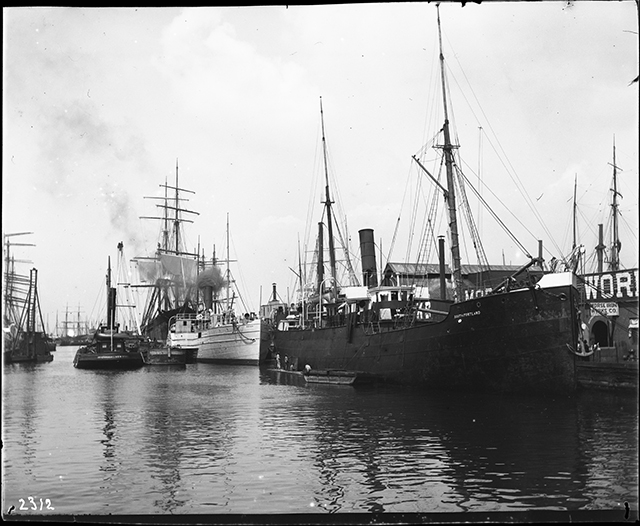
SOUTH PORTLAND (SCREW SCHOONER: 1892-1905) - ROVER (SIDEWHEEL STEAMBOAT: 1881) - JAMES S.T. STRANAHAN (STEAMBOAT: 1883)
South Portland - Rover; 2312
Steamboats–United States.; Sailing ships–United States.; Harbors–United States.
Shows a view looking into a harbor with steamships, tugboats, and sailing ships. Stanton's notebooks contain the following information about this item: "Aug 26 96"
United States–History–Casualties. Civil War, 1861-1865
African American sailors.
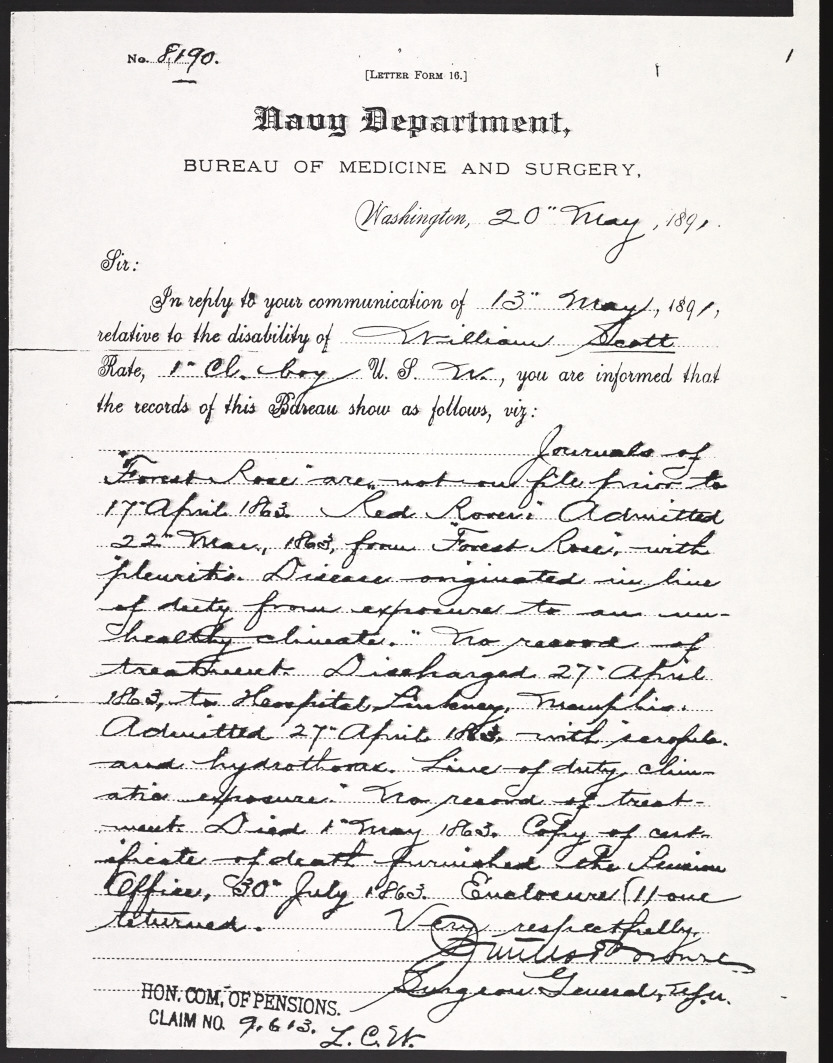
Photocopy of a one-page letter signed J. Mills Browne, Surgeon General of the Navy, to the Commissioner of Pensions regarding the disability and death of William Scott of the Forest Rose, including his treatment aboard the hospital ship Red Rover.
United States–History–Casualties. Civil War, 1861-1865
African American sailors.
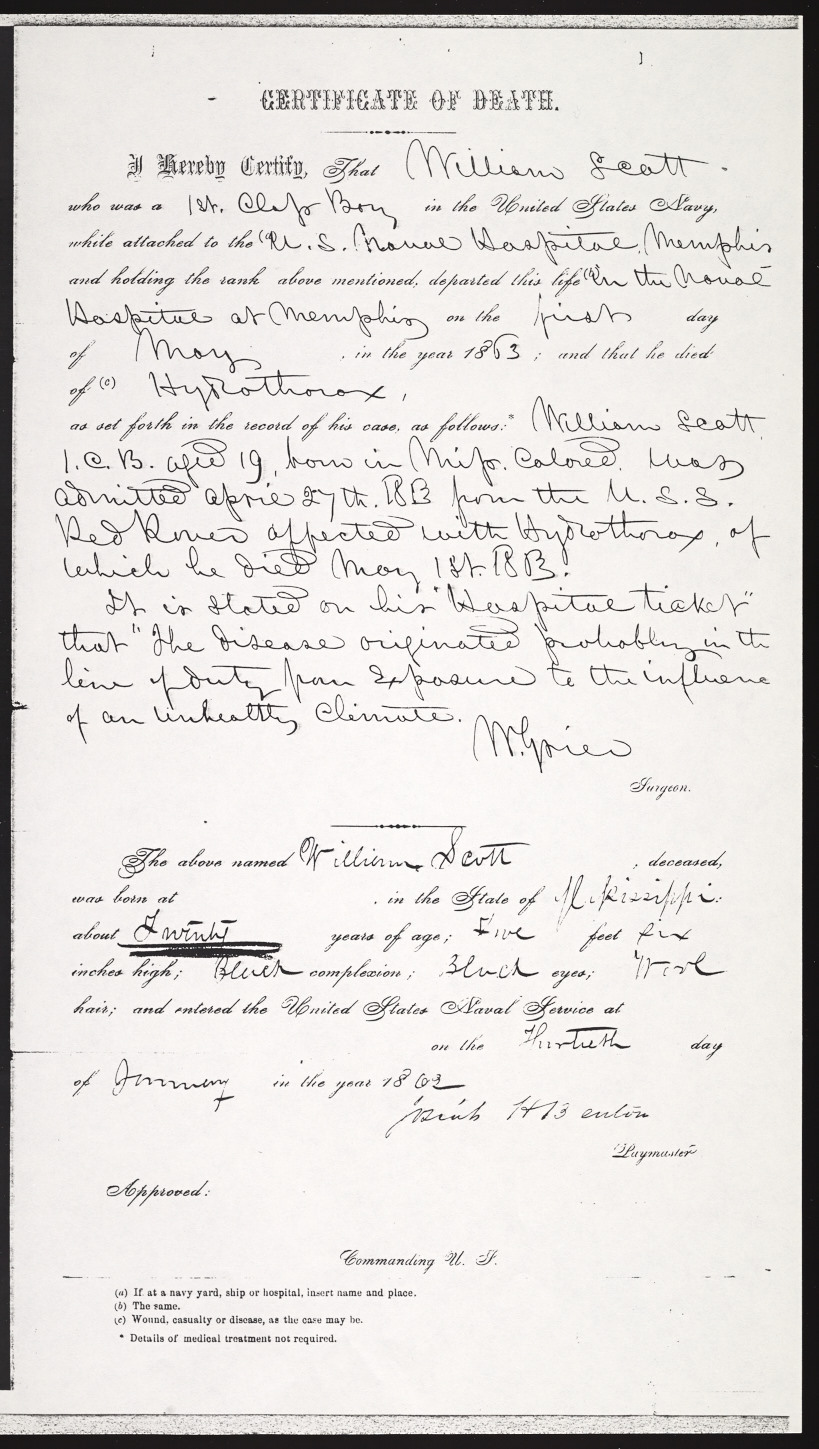
Photocopy of the one-page death certificate for William Scott dated May 1, 1863. The attending physician notes his treatment on Red Rover and states that the disease that killed him probably originated in the line of duty from exposure.
Mrs. Elizabeth Rover, Beckley, W.Va., saleslady of the tobacco, candy and magazine departments. Photo taken during the opening of the New Main Post Exchange, HRPE, Newport News, Va.
Clerks (Retail trade)–Virginia–Newport News.
Shows a saleswomen standing behind the counter in the candy and tobacco department of the Main PX.
Miss Mabel Lescure, Roanoke, Va., and Mrs. Elizabeth Rover, Beckley, W.Va., salesladies of the tobacco, magazine and candy departments. Photo taken at opening of the New Main Post Exchange, HRPE, Newport News, Va.
Clerks (Retail trade)–Virginia–Newport News.
Shows two saleswomen standing behind the counter in the magazine department of the Main PX. Some titles for sale include: Official Detective, Companion, Laff, and Western. It appears that comic books are also for sale.
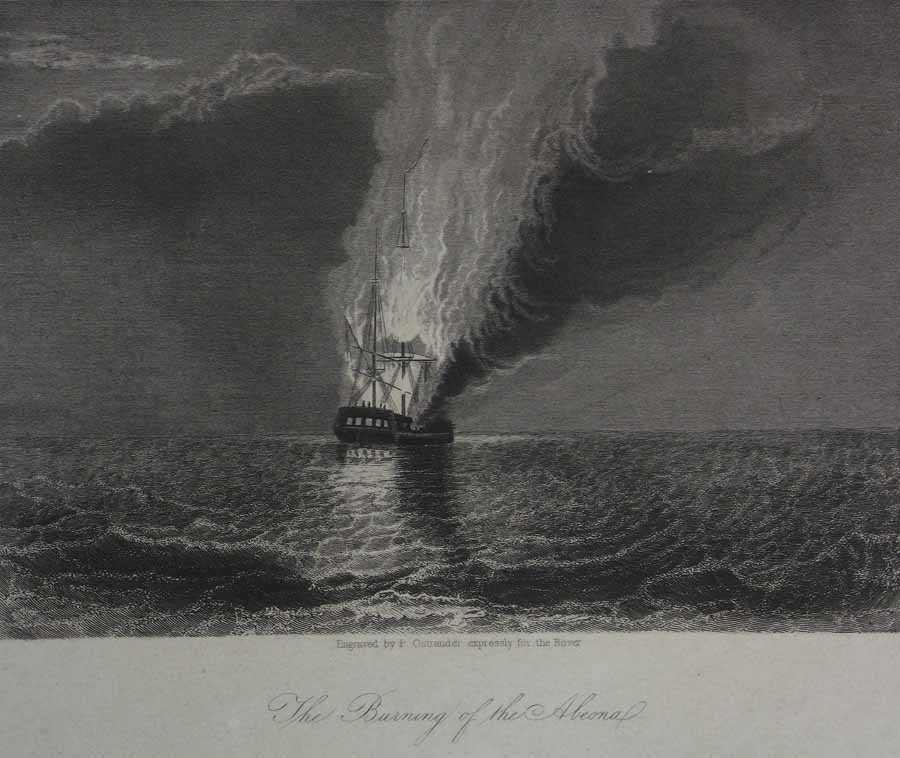
NOTES: From The Rover, A Weekly Magazine of Tales, Poetry and Engravings, vol. 1, Published by Labree, Dean & Co., 162 Nassau Street, New York, 1843 NOTES: A party of Scots artisans and trademen sailed from Greenock in the Abeona on 13 October 1820. At sea on 25 November, in latitude 4° 30' N and longitude 25° 30' W, the ship caught fire, and after burning for fifteen hours was totally destroyed. Three small boatloads of survivors were rescued by a Portuguese merchant ship; 16 of the crew including the master, 27 emigrants and nine passengers were saved, and 114 people - nine of the crew, 100 emigrants and five passengers - were lost with the ship.
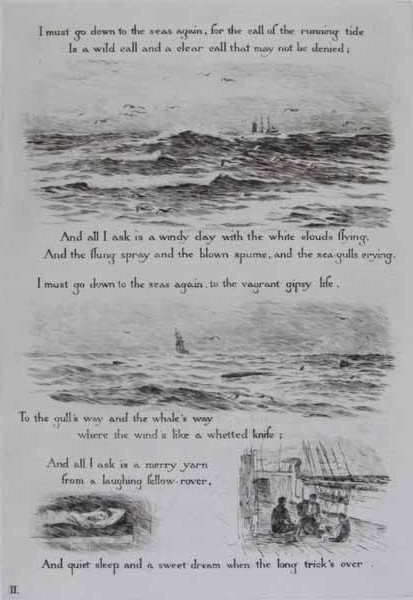
NOTES: Plate No. 2 located in object file. From ROBERT BUNTING The Rembrandt Gallery 12 Water Street Liverpool, 2 "Sea Fever, Plate No. 2 Illustrating the Poem by John Masefield Original Etching by Lt. Com Rowland Langmaid
WRITTEN ON VERSO:FORMERLY SUCROSA, BUILT 1916 AT QUINCY, MASSACHUSETTS BY THE FORE ROVER SHIPBUILDING CORPORATION. OWNED BY CITES SERVICE OIL COMPANY, 5,343.7 T , 389 X54.7 X 293.
NOTES: American Privateer Schooner, 1813. VESSEL INFORMATION - VESSEL NAME: PRINCE DE NEUFCHATEL NATIONALITY: American VESSEL TYPE: Privateer CAPTAINS OR OTHER RELATED PEOPLE: Captain Ordronaux VESSEL DIMENSIONS: 310 tons DIMENSIONS: 117'3" x 26' x 11'6" ARMAMENT: 16-12 pdr carronades, 2-6 pdr long guns COMPLEMENT: 120 DESIGNER: Adam & Noah Brown BUILD DATE: New York, 1813 VESSEL HISTORY: Fitted out at Cherbourg, France and entered a brief but energetic and successful career as an American Privateer, raiding British commerce. She was armed with 17 guns and was first commanded by Captain Ordronaux. On one cruise she captured nine valuable prizes, most of them being sent to French ports, the other burned or otherwise destroyed. After a brief season around the French and English coast, the NEUFCHATEL crossed the Atlantic and continued her activities from Boston, Massachusetts. From this port she had innumerable and successful encounters with British ships of greater tonnage and fire power. She was finally captured by three British frigates, which had been trying to locate and capture the Constitution. She was sailed to England with a prize crew. She was placed in dry dock and her lines taken off. She was refitted and armed for future use in the British Navy. However, the vessel's back was broken taking her from the graving dock with the result that she never sailed the seas again. [http://rasputin.physics.uiuc.edu/~wiringa/Ships/Period1/UnitedStates/PrincedeNeufchatel.html] Notes: Owned by Madame Flory Charretton. Letter-of-marque issued to her son-in-law J.Ordronaux, 28 Oct 1813. Sent to France and fitted out as a privateer at Cherbourg. Service: At sea in March 1814 she took nine prizes in the English Channel, and then another six in June. She was chased by 17 British men-of-war during her cruises, but her great speed allowed her to escape each time. Refitted at Boston in Sep 1814. In Oct 1814 she had a bloody battle with boats from the British frigate Endymion with heavy casualties on both sides, but she again escaped. Madame Charretton having passed away, the Neufchatel was purchased for $21,000 by Ordronaux and two other trustees, J.H.Beylle and Peter E. Frevall, who were issued a new letter-of-marque 12 Dec 1814. Shortly after her next sailing, she was sighted on 28 Dec by the British frigate Newcastle and two other frigates and finally caught after an all-day pursuit in a heavy gale. She was sent to England to be surveyed for purchase into the Royal Navy, but she was damaged in dry dock, and sold off. Her lines were reportedly later used in the design of a famous opium-smuggler, the Red Rover.
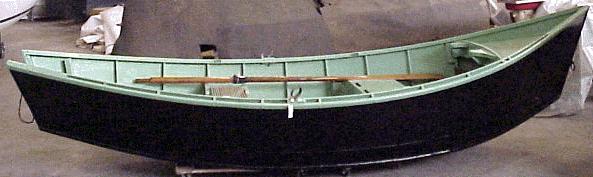
LABEL COPY: McKenzie River Drift Boat, circa 1949 McKenzie River Boat Co., Oregon Donated by James F. Curtin in memory of all who have gone to sea, and those who waited for them to return The McKenzie River runs west from Oregon's Cascade Mountains to the Pacific Ocean. Known for its abundance of salmon and cutthroat, rainbow, and steelhead trout, it has been popular with sport fishermen since the early 20th century. The fast, turbulent McKenzie requires a light, maneuverable boat. The fisherman stands in the front, facing upstream, as a guide steers the boat using a pair of oars. The shape of the bottom and the high ends make it possible for the guide to use the current to control the boat as it drifts backwards downstream. (2000.39.1 BU; ID 2; Maritime Environment; International Small Craft Center 5/2003) VESSEL INFORMATION - BOAT NAME: McKENZIE RIVER DRIFT BOAT VESSEL DIMENSIONS: 14-9-0 (length OA); 5-11-0 (Beam) ORGIN: McKenzie River DATE: circa 1949 NOTES: This boat was designed for use in the fast flowing rivers of western Oregon. The boat has removable floorboards, metal oarlocks, and a pair of long oars. The boat is essentially sound, with the exception of some soft wood on one of the rails and near one of the oarlocks. Some of the original paint has flaked off and the entire boat needs repainting. Plan view of the drift boat drawn by Lyles Forbes available in object file CURATOR'S NOTES: [Lyles Forbes, December 19, 2000] Known as a drift boat because it is designed to float, or drift, downstream. It actually drifts transom-first, or stern-first. The guide or rower actually faces the bow but not in the direction the boat is headed. Very maneuverable craft with an extreme amount of rocker in the gull. To maintain control, the guide rows upstream so the boat drifts downstream. Prototype of the McKenzie River drift boat developed by Norwegian immigrant Tom Kaarhus in 1910. The next stage in the evolution came in 1939 with the incorporation of marine plywood. The guide seat is made of rope allowing the rover a non-slip surface from which to pull hard on the oars. It also does not get slick when wet as would a normal seat. There are two braces attached to the decked area that provide support for someone to stand and fly-fish. The donor states that the color of the drift boat is "Army latrine green" used to paint toilet facilities. The donor also stated that two rub rails were mounted on the hull to prevent tire damage from a Model A Ford to the boat. The sides and hull bottom of the boat are of marine plywood. ADDITIONAL INFORMATION: See object file for three photos of this vessel in use by previous owner; Babbs, John. "The McKenzie River Drift Boat". Woodenboat 52, 81-83; Fletcher, Roger. "Oregon's Early Drift Boats: A Tale of Two Rivers". Wooden Boat Magazine. pp. 50-57. November/December 1999.; Aak to Zumbra: A Dictionary of the World's Watercraft. The Mariners' Museum. 2000; Drift Boat Kits website: http:\\www.gregboats.com\pages\driftboats.html; "Historic drift boats as "eddies of evolution". (explanation for rubrails) Evolution of Drift Boats website: http:\\www.riverstouch.com\Evolutionofdriftboats.html VESSEL INFORMATION- VESSEL HISTORY: The boat was built in Oregon (date unknown) for Dr. Clem Hayes by McKenzie River Boat Company. It was purchased in 1950 by Bernard Stacy. He modified one end of the boat to mount a small outboard motor. He used it on the lakes and rivers of Oregon, and also launched it in the Pacific surf to fish on Tillamook Bay. Mr. Stacy then gave the boat to Major General (Retired) Robert and Joanne Sunnell. The Sunnells transported it to Virginia in the early 1980's. The Sunnells gave the boat to Mr. and Mrs. Frank Mastaler in 1990 and the Mastalers gave it to the donor in 1999.
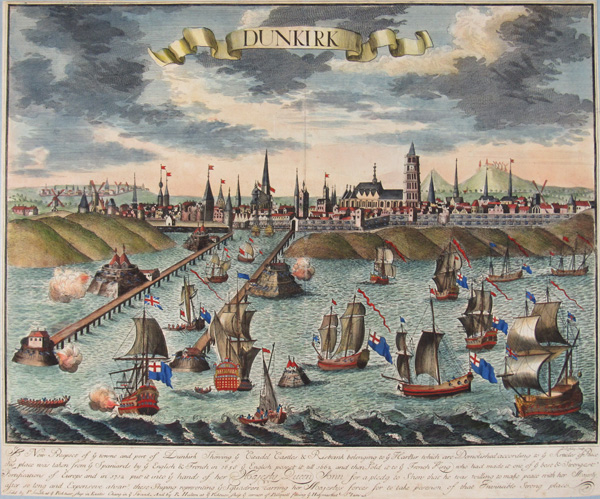
ADDITIONAL INFORMATION: Text from "The House of Cromwell and the story of Dunkirk" by James Waylen: In 1694 a grand assault was made on the sea-defences of Dunkirk by a combined fleet of sixty Dutch and English vessels. It began and ended in smoke. The attempt was renewed in the following year by a flotilla of a hundred and twelve vessels; but the armed jetty, covered by a floating battery, effectually prevented any approach. Neither shot nor shell reached the city, and the assailants retired with the loss of one frigate and four smaller craft. These and other events of that date brought into notice and have since perpetuated the name of Jean Bart, the renowned rover of Dunkirk. His adventures fall not within our limits. His memory is cherished by his fellow townsmen, and his statue dominates their principal square, hence called "La place Jean Bart." But the freebooter's trade, prolific in spoil as it might be to the adventurers themselves and rich in romance for the gossips of Paris, was hardly compatible with national treaties of commerce; and it was an unwelcome discovery, which the Dunkirkers were slow to learn, that union with France involved for all future time the loss of their independence. The first serious check to their triumphs was the following clause in the Treaty of Utrecht;—"The most Christian King undertakes to level the fortifications of Dankirk, to block up the port, and to demolish the sluices which scour the harbour,—with this further condition, that such fortifications, port, and sluices, shall never be re-constructed." An English army was thereupon permitted to take possession of the place, and the townsfolk had to witness in silence all the materials of their maritime splendour levelled with the dust. In anticipation of their arrival, M. le Blanc the Intendant of Flanders and M. le Comte de Lomond the governor of the town met to arrange the terms of transfer, when it was wisely agreed that the French garrison should entirely evacuate Dunkirk for the time being, and march to Bergh, which accordingly they did on the evening of the 19th Oct. Twelve English vessels of war and twenty transports then arrived, carrying 6722 men under Mr. Hill the temporary governor. The work of demolition commenced in October 1713 and was completed in the following March. There is a large folio print in the British Museum Library, engraved by D. Lockley, being a bird's eye view, supposed to be taken from the sea, and entitled,—"A new prospect of the town and port of Dunkirk, with the citadels, castles, and Risban, belonging to the harbour, which are demolished according to the articles of peace." Twelve or more large ships occupying the foreground represent, so the letterpress informs us, " the squadron carrying her Majesty's forces to take possession of that invincible strong place."
MANCHESTER - NEW HAMPSHIRE - UNITED STATES - Maker
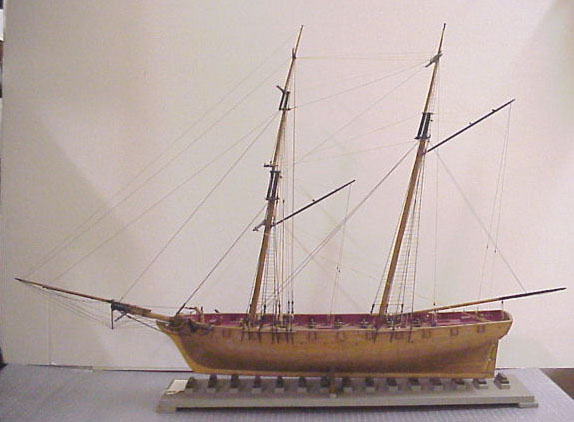
NOTES: Samples of rigging line removed from model during repairs of damage in April, 1981 are in object file. See object file for information sheet giving crating and uncrating information. Model is built with separate planking. Square rigged on foremast, schooner rigged rear mast, no canvas. The boat mounts 14 guns, 7 on a side, has water barrels and buckets on deck, scuppers and a sort of capstan or windlass which works, for raising the anchors, a companion way forward with ladder to lower deck, a hatchway amidships with ladder, a cabin aft with ladder. The cabin contains a bunk on either side and a mess table in center. Rudder handles with a tiller. Also has a short stack or pipe above decks leading presumably from the ship's galley. Porthole covers open and shut. VESSEL INFORMATION - VESSEL NAME: PRINCE DE NEUFCHATEL NATIONALITY: American VESSEL TYPE: Privateer CAPTAINS OR OTHER RELATED PEOPLE: Captain Ordronaux VESSEL DIMENSIONS: 310 tons DIMENSIONS: 117'3" x 26' x 11'6" ARMAMENT: 16-12 pdr carronades, 2-6 pdr long guns COMPLEMENT: 120 DESIGNER: Adam & Noah Brown BUILD DATE: New York, 1813 VESSEL HISTORY: Fitted out at Cherbourg, France and entered a brief but energetic and successful career as an American Privateer, raiding British commerce. She was armed with 17 guns and was first commanded by Captain Ordronaux. On one cruise she captured nine valuable prizes, most of them being sent to French ports, the other burned or otherwise destroyed. After a brief season around the French and English coast, the NEUFCHATEL crossed the Atlantic and continued her activities from Boston, Massachusetts. From this port she had innumerable and successful encounters with British ships of greater tonnage and fire power. She was finally captured by three British frigates, which had been trying to locate and capture the Constitution. She was sailed to England with a prize crew. She was placed in dry dock and her lines taken off. She was refitted and armed for future use in the British Navy. However, the vessel's back was broken taking her from the graving dock with the result that she never sailed the seas again. [http://rasputin.physics.uiuc.edu/~wiringa/Ships/Period1/UnitedStates/PrincedeNeufchatel.html] Notes: Owned by Madame Flory Charretton. Letter-of-marque issued to her son-in-law J.Ordronaux, 28 Oct 1813. Sent to France and fitted out as a privateer at Cherbourg. Service: At sea in March 1814 she took nine prizes in the English Channel, and then another six in June. She was chased by 17 British men-of-war during her cruises, but her great speed allowed her to escape each time. Refitted at Boston in Sep 1814. In Oct 1814 she had a bloody battle with boats from the British frigate Endymion with heavy casualties on both sides, but she again escaped. Madame Charretton having passed away, the Neufchatel was purchased for $21,000 by Ordronaux and two other trustees, J.H.Beylle and Peter E. Frevall, who were issued a new letter-of-marque 12 Dec 1814. Shortly after her next sailing, she was sighted on 28 Dec by the British frigate Newcastle and two other frigates and finally caught after an all-day pursuit in a heavy gale. She was sent to England to be surveyed for purchase into the Royal Navy, but she was damaged in dry dock, and sold off. Her lines were reportedly later used in the design of a famous opium-smuggler, the Red Rover.
NEW BEDFORD - MASSACHUSETTS - UNITED STATES - Artist
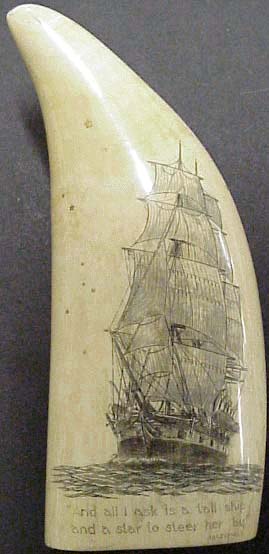
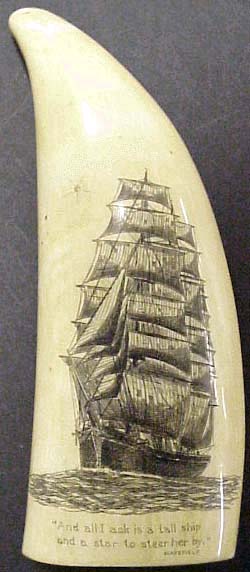
SHORT DESCRIPTION: Sperm whale tooth, engraved with a port bow view of unidentified whaleship, probably the Charles W. Morgan. The legend below the vignette reads "And all I ask is a tall ship and a star to steer her by", Masefield." Inked in black and blue. Part of a set by artist Harry Neyland that includes pieces IS476-IS560. Made between 1934 and 1939. NOTES: The legend under the image is the second line of the first stanza of English poet John Masefield's poem 'Sea Fever.' The full text of the poem is: I must go down to the seas again, to the lonely sea and the sky, And all I ask is a tall ship and a star to steer her by; And the wheel’s kick and the wind’s song and the white sail’s shaking, And a grey mist on the sea’s face, and a grey dawn breaking. I must go down to the seas again, for the call of the running tide Is a wild call and a clear call that may not be denied; And all I ask is a windy day with the white clouds flying, And the flung spray and the blown spume, and the sea-gulls crying. I must go down to the seas again, to the vagrant gypsy life, To the gull’s way and the whale’s way where the wind’s like a whetted knife; And all I ask is a merry yarn from a laughing fellow-rover, And quiet sleep and a sweet dream when the long trick’s over. NOTES: In 1941 the Museum received 85 pieces of scrimshaw (IS476-IS560) through bequest from the Robert Lyons Hague estate. Over the years, there has been discussion about the artist of the items. In 1989, Mariners’ Museum curator Richard Malley states in a letter that the artist of the pieces of scrimshaw with Neyland images (IS 476, IS489-493, IS 499 and IS 520) is unclear. During a visit on November 8, 1983 and again in 1996, Gary Eckstein, a collector of modern scrimshaw visited the museum to look at the collection of scrimshaw to identify possible pieces by artist William Perry. During his visits he attributed several teeth to Frank/Francisco Rapoza (IS 476-probably late Rapoza); IS483 Rapoza?; IS491-492-Rapoza; IS503-Rapoza?; IS505, 509, 511-514, 517-Rapoza). He mentioned during his visit that artist Harry Neyland had worked with Robert L. Hague to assemble his scrimshaw collection and that Mr. Hague had requested that a number of teeth be etched depicting life aboard a whaler, the men and their jobs. Commenting on some of the pieces he reviewed Eckstein stated they were “not by Rapoza nor William Perry. Probably a third person.” In an April 1, 1986, letter to Mr. Eckstein, Research Associate Lois Oglesby states that curator Richard Malley had deferred to Mr. Eckstein’s opinion on the attribution because modern scrimshaw was “out of the time period of his expertise.” Mr. Eckstein also sold a Rapoza signed tooth to the Museum in 1996 (1996.01.01). However, several letters from Harry Neyland to Fred Hill (dated July 20, 1939) and Homer L. Ferguson, president of the Museum (dated August 2, 1939), clarifies the issue of who created the scrimshaw in Mr. Hague’s collection. The July 20th letter states: “Cuthbert, brother of the late Robert L. Hague told me that you had seen the collection of scrimshaw I made for him which he willed to your museum. All told there are 22 more whale’s teeth some finished, others which are in various stages, which were ordered by Mr. Hague to complete the set. He was very anxious to have every whaling term illustrated in the set...The last time I saw Mr. Hague was the first of February when I delivered some of the finished work. I spent considerable of my own money buying the whales teeth also have spent many weeks work on them to date. Mr. Hague’s brother asked me if I wished to enter my claim against his brother’s estate so as to get my money for my labor and expenses for completing the set. I told him his brother had paid me for all I had delivered and I did not like to file a claim as possibly the museum, since they received such handsome bequests should prefer to assume the small amount to settle my claim. I can not afford to lose the pay for my time nor the money I have paid out to buy the whales teeth…I have been working over five years on this collection and am personally proud of it.” The August 2, 1939 letter to Mr. Ferguson states: “For nearly five years I have devoted as much time, as my eyes would permit, to making a collection of scrimshaw for Robert…I spent many hours with him planning this collection…The last time I saw Robert was the first week of February. I met him at his apartment, at six, we dined together and practically the whole evening until midnight was spent in planning the completion of the collection, illustrating every known term or phrase used in whaling…After the completion of the whaling series, Robert had commissioned me to illustrate the naval battles of the U.S., also for your museum…Cuthbert told me that your Mr. Hill had called to see his late brother’s collections, willed to your museum. He no doubt can inform you regarding the collection above mentioned, which when finished, will not only be the best collection of scrimshaw, but the only one of its kind in existence. Knowing that the collection was to be on permanent exhibit in a public museum I took great care to see that all details were correct from a nautical standpoint also that artistically they would be beyond criticism. I take a personal pride in the work and I am anxious to see it completed…I have spent many days work on this, for which I have received no remuneration [regarding the 22 unfinished teeth].” Unfortunately, Hill and Ferguson decided against assuming “the burden of paying for the [completion of the] twenty-two additional pieces ordered from you by Mr. Hague” but they agreed to work with Mr. Neyland on the restoration of some of the damaged pieces. It’s also important to note that according to his letters, Harry Neyland promised Mr. Hague, and may have been contractually restricted, not to make another set like the one Hague intended to present to the Museum. In the July 20 letter he states “I agreed not to make a set for any other individual or museum.” In the August 2 letter he states the collection is “the only one of its kind in existence” and “My hands are tied for I signed a written agreement for Robert promising not to make another whaling set for anyone, nor to duplicate any of the designs.”
NEW BEDFORD - MASSACHUSETTS - UNITED STATES - Artist
SHORT DESCRIPTION: Sperm whale tooth engraved on obverse with port bow view of full rigged ship. Title: "And all I ask is a tall ship and a star to steer her by." MASEFIELD" Inked in black and blue. Part of a set by artist Harry Neyland that includes pieces IS476-IS560. Made between 1934 and 1939. NOTES: The legend under the image is the second line of the first stanza of English poet John Masefield's poem 'Sea Fever.' The full text of the poem is: I must go down to the seas again, to the lonely sea and the sky, And all I ask is a tall ship and a star to steer her by; And the wheel’s kick and the wind’s song and the white sail’s shaking, And a grey mist on the sea’s face, and a grey dawn breaking. I must go down to the seas again, for the call of the running tide Is a wild call and a clear call that may not be denied; And all I ask is a windy day with the white clouds flying, And the flung spray and the blown spume, and the sea-gulls crying. I must go down to the seas again, to the vagrant gypsy life, To the gull’s way and the whale’s way where the wind’s like a whetted knife; And all I ask is a merry yarn from a laughing fellow-rover, And quiet sleep and a sweet dream when the long trick’s over. NOTES: In 1941 the Museum received 85 pieces of scrimshaw (IS476-IS560) through bequest from the Robert Lyons Hague estate. Over the years, there has been discussion about the artist of the items. In 1989, Mariners’ Museum curator Richard Malley states in a letter that the artist of the pieces of scrimshaw with Neyland images (IS 476, IS489-493, IS 499 and IS 520) is unclear. During a visit on November 8, 1983 and again in 1996, Gary Eckstein, a collector of modern scrimshaw visited the museum to look at the collection of scrimshaw to identify possible pieces by artist William Perry. During his visits he attributed several teeth to Frank/Francisco Rapoza (IS 476-probably late Rapoza); IS483 Rapoza?; IS491-492-Rapoza; IS503-Rapoza?; IS505, 509, 511-514, 517-Rapoza). He mentioned during his visit that artist Harry Neyland had worked with Robert L. Hague to assemble his scrimshaw collection and that Mr. Hague had requested that a number of teeth be etched depicting life aboard a whaler, the men and their jobs. Commenting on some of the pieces he reviewed Eckstein stated they were “not by Rapoza nor William Perry. Probably a third person.” In an April 1, 1986, letter to Mr. Eckstein, Research Associate Lois Oglesby states that curator Richard Malley had deferred to Mr. Eckstein’s opinion on the attribution because modern scrimshaw was “out of the time period of his expertise.” Mr. Eckstein also sold a Rapoza signed tooth to the Museum in 1996 (1996.01.01). However, several letters from Harry Neyland to Fred Hill (dated July 20, 1939) and Homer L. Ferguson, president of the Museum (dated August 2, 1939), clarifies the issue of who created the scrimshaw in Mr. Hague’s collection. The July 20th letter states: “Cuthbert, brother of the late Robert L. Hague told me that you had seen the collection of scrimshaw I made for him which he willed to your museum. All told there are 22 more whale’s teeth some finished, others which are in various stages, which were ordered by Mr. Hague to complete the set. He was very anxious to have every whaling term illustrated in the set...The last time I saw Mr. Hague was the first of February when I delivered some of the finished work. I spent considerable of my own money buying the whales teeth also have spent many weeks work on them to date. Mr. Hague’s brother asked me if I wished to enter my claim against his brother’s estate so as to get my money for my labor and expenses for completing the set. I told him his brother had paid me for all I had delivered and I did not like to file a claim as possibly the museum, since they received such handsome bequests should prefer to assume the small amount to settle my claim. I can not afford to lose the pay for my time nor the money I have paid out to buy the whales teeth…I have been working over five years on this collection and am personally proud of it.” The August 2, 1939 letter to Mr. Ferguson states: “For nearly five years I have devoted as much time, as my eyes would permit, to making a collection of scrimshaw for Robert…I spent many hours with him planning this collection…The last time I saw Robert was the first week of February. I met him at his apartment, at six, we dined together and practically the whole evening until midnight was spent in planning the completion of the collection, illustrating every known term or phrase used in whaling…After the completion of the whaling series, Robert had commissioned me to illustrate the naval battles of the U.S., also for your museum…Cuthbert told me that your Mr. Hill had called to see his late brother’s collections, willed to your museum. He no doubt can inform you regarding the collection above mentioned, which when finished, will not only be the best collection of scrimshaw, but the only one of its kind in existence. Knowing that the collection was to be on permanent exhibit in a public museum I took great care to see that all details were correct from a nautical standpoint also that artistically they would be beyond criticism. I take a personal pride in the work and I am anxious to see it completed…I have spent many days work on this, for which I have received no remuneration [regarding the 22 unfinished teeth].” Unfortunately, Hill and Ferguson decided against assuming “the burden of paying for the [completion of the] twenty-two additional pieces ordered from you by Mr. Hague” but they agreed to work with Mr. Neyland on the restoration of some of the damaged pieces. It’s also important to note that according to his letters, Harry Neyland promised Mr. Hague, and may have been contractually restricted, not to make another set like the one Hague intended to present to the Museum. In the July 20 letter he states “I agreed not to make a set for any other individual or museum.” In the August 2 letter he states the collection is “the only one of its kind in existence” and “My hands are tied for I signed a written agreement for Robert promising not to make another whaling set for anyone, nor to duplicate any of the designs.”
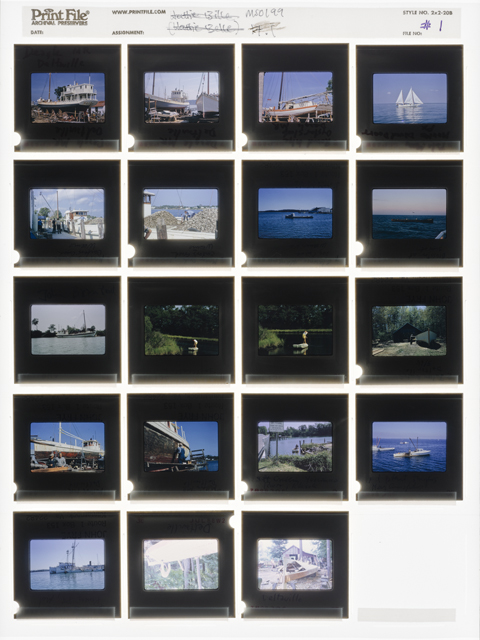
Chesapeake Bay (Md. and Va.).; Chesapeake Bay Region (Md. and Va.)–Photographs.; Coan River (Va.)–Photographs.; Potomac River–Photographs.; Rappahannock River (Va.)–Photographs.; Yeocomico River (Va.)–Photographs.
Sailboats–Chesapeake Bay (Md. and Va.)–Photographs.; Marine railways–Chesapeake Bay Region (Md. and Va.)–Photographs.; Rivers–Chesapeake Bay Region (Md. and Va.)–Photographs.; Crabbing–Chesapeake Bay Region (Md. and Va.)–Photographs.; Waterways–Chesapeake Bay Region (Md. and Va.)–Photographs.; Historic sites–Chesapeake Bay Region (Md. and Va.)–Photographs.; Schools–Chesapeake Bay Region (Md. and Va.)–Photographs.; Boatyards–Chesapeake Bay Region (Md. and Va.)–Photographs.; Fishing boats–Chesapeake Bay (Md. and Va.)–Photographs.; Dogs–Chesapeake Bay Region (Md. and Va.)–Photographs.; Ships–Scrapping–Chesapeake Bay Region (Md. and Va.)–Photographs.; Boaters (Persons)–Chesapeake Bay (Md. and Va.)–Photographs.; Estuaries–Chesapeake Bay Region (Md. and Va.)–Photographs.; Wharves–Chesapeake Bay (Md. and Va.)–Photographs.; Waterfowl–Chesapeake Bay (Md. and Va.)–Photographs.; Kayaks–Chesapeake Bay (Md. and Va.)–Photographs.
Contains photographic negatives of Deagle marine railway in Deltaville, Virginia, soft-crabbing on the Yeocomico river, images of unspecified waterways around the Chesapeake Bay area, copies of artwork by unspecifiied artists, Salt Pond, tide mills, Municipal Research and Services Center Hampton hearing, School of Seamanship in Piney Point, Maryland, boats in Joseph Conboy yard, "Colleen" breakup, Coast Guard commission of the "Milford Huron S & R Steton", compass demonstation at White Point marina, Hull Creek, Jack Hope and kayak, boat dogs, Diving Creek, the yacht "Mad Mark", Dr. Geo B. Crust and "Little Maid", O. W. Johnson, the boat " Black Arrow", Crab Point, Cookie Francis home, Coan river at low tide, watermen, Kendall Long's "Shark's Tooth", estruation, West Point, Lewisetta, Sandy Point, Coan Wharf, Hokomes Landing, Rover Landing, the boat "Fleeton Ariel" from water, Artesan Wells, Potomac river ducks, cormorants, Chesapeake National "Boat'n Bank", Bowe's Landing, the Virginia Institue of Marine Science on Rappahannock river, general photographs of Urbanna, Virginia, Joseph L. Conboy & Assts., sailboats, adapts, Coast Guard oil recovery demonstration in Norfolk, Virginia, Joseph L. Conboy, Urbanna Echo Trails, Richmond boats, Colonel Berch, "Heaven's Sahe", Indian Creek, Durding Creek, Conboy marine railway, Cronkite boat, pike, Weems, Virginia, wiley boats, the boat "Infinity", stanford boats, Colonel Beads, Chesapeake Bay Foundation, ecological cruise, Euell Biffous, Marine Resources Study Commission run, Grady Lester, Accomac stranded ferry,"Fleeton Bearly", Damason's Marsh, Hack's Heck Potomac River Park site, and Accomack waterway.
BOSTON - MASSACHUSETTS - UNITED STATES - Related Place
SHORT DESCRIPTION: Oil painted board covered with white canvas. Sailors stand at either end of the board each holding the spokes of a large steering wheel. There is a large eagle with wings spread over a United States shield. A banner in his beak reads "Private Signals of the Merchants of Boston, Mass. NOTES: Before the advent of the electric telegraph, a system of flag signals was in use, the merchants of Boston having a set of one hundred and twelve private signals, each one a different flag. When a ship arrived, the owner's color was run up at Hull, repeated on an island in the harbor, again shown on Central Wharf, and finally at the old State House. NOTES: The painting appears to be severely overpainted as some of the merchants names are spelled incorrectly. There are photographs in the object file which seem to show the painting undergoing some sort of "restoration" in the shipyard's model shop in the 1930s or 1940s. The painting was faced with tissue and varnish in the 1970s to try and hold the painted surface together. It has remained that way ever since. This may be the original painting from which the well-known lithograph by Kramer & Co. was created from. There are some mistakes in the rendering of the signal flags that may be attributed to the heavy overpaint. For example: in column 7 a rectangular flag with a yellow field and blue dot has no name underneath (T. S. Davis & Co.) and in column 8 the Higgins & Co. flag is portrayed as a rectangular shape with white field and blue dot when its supposed to show a swallowtail shape with white field and blue dot. NOTES: For references below see object file. Iasici, Goddard, & Co. is also spelled Iasigi or Jasigi. The partners were Joseph Jasigi and Thomas A. Goddard. From Joseph’s 1897 obituary, he came to Boston from Armenia in 1830 and formed the partnership. His son, Joseph Andrew Jasigi, was born in 1848 and eventually became a partner. Joseph Andrew went on to be a consul general to Turkey but was arrested for embezzling $220,000, for which he spent 12 years in prison. J. H. Cheney operated in the 1840s and 1850s as a merchant and ship broker. By 1855 he had offices at 4 India wharf. Larkin & Stackpole Co. - Charles Larkin and David D. Stackpole (1811-1879) started the company in 1852 and continued until 1877 when it became Larkin & Cutting with Andrew Cutting. F. Nickerson & Co was Fred W. Nickerson (1808-1879), the company name became F.W. Nickerson & Co. after Fred died. F.W. Nickerson included Frederick W. Nickerson, Alfred A. Nickerson, and Elkanan C. Crosby but their company failed in 1886 after their ship, City of Columbus, sank. Blanchard, Sherman & Co. included Alfred Blanchard, Elisha Sherman, and George Baker. They were in business as commission merchants from the 1840s to mid-1860s. Sampson & Tappan were George R. Sampson and Lewis W. Tappan. They were co-owners of the Stag Hound with George B. Upton, which was an extreme clipper built by Donald MacKay. One of their New York representatives was Vernon H. Brown who later worked for Cunard Steam Ship Company. One of the largest shipowners in Boston. N. & B. Goddard - Nathaniel Goddard had an office at 24 Union wharf in 1836 but failed before Panic of 1857. W. M. Ropes & Co. - William H. Ropes and Joseph S. Ropes had offices at 36 India wharf 1848. They had relocated to 25 Lewis wharf by 1855 but by then the partners were William H. Hardy and Joseph S. Ropes. The company was still in business there in 1862 with William Ropes, Hardy Ropes, and Joseph S. Ropes as partners. Homer & Sprague - Richard T. Sprague and Charles Homer appear in the papers as early as 1843. They had offices at 36 India wharf by 1855 and were still there by 1872. Page, Richardson & Co. dissolved in 1875. Dabney & Cunningham - Frederic Cunningham (1826-1864) and his cousin, Charles William Dabney, Jr. started the company in 1848 but closed when Cunningham died. Their offices were at 59 Commercial wharf and they owned the ships Harbinger, Pomona, Grampus, Melita, Io, Mermaid, Lotos, Azor, and Fredonia. A. Cunningham & Sons started in 1822 as A. & C. Cunningham (Andrew & Charles) but Charles retired in 1849 so Andrew's sons, James Henry Cunningham and Charles West Cunningham became partners and the name changed to A. Cunningham & Sons. Charles' son, Frederick, helped start Dabney & Cunningham above. Crowell, Lewis & Co. was Joseph D. Crowell, William H. Lewis, and George T. Lovell. They were ship chandlers at 120 Commercial wharf in 1852, and also appear in the 1872 city directory. Zadoc C. Crowell was a senior partner when he died in 1887. E. Atkins was Elisha Atkins, he started working with William F. Freeman in 1838 as Atkins & Freeman, but went into business alone in 1849 until 1866 when John W. Cummings became a partner and the company became Atkins & Co. Elisha died in 1888 but Atkins' son and grandson eventually joined the company as late as 1915. Baker & Morrill was Ezra H. Baker and Charles J. Morrill. The company started in 1840s as Baker & Hardy with Alpheus Hardy. When Morrill worked his way up from bookkeeper to partner in 1845 the name changed to Hardy, Baker, & Morrill. When Hardy retired the name became Baker & Morrill. They owned the ship Southern Cross, built in 1851. Daniel Draper & Son - Daniel (1788-1867), by 1855 William Perkins Draper was in control with offices at 20 S. Market. A.C. Hersey was Alfred C. Hersey (1804-1888), a merchant at 67 Commercial wharf by 1855. His obituary states, he "was the largest owner and wharfinger of Commercial wharf for 25 years,” and he was also a partial owner in at least 40 different vessels. Charles S. Brown & Co. were commercial merchants at 11 Custom House Street in 1855 city directory. By 1857 and again in 1858 they are at 28 India Wharf. Geo. M. Barnard was George M. Barnard, who appears in the papers as early as the 1840s. He had offices at 41 Commercial wharf by 1855, and in 1866 contributed money toward the purchase of a school ship, it was sold in 1872. John H. Foster & Co. were grain merchants but the company was suspended in 1880. Howes & Crowell - Osborn Howes was born in 1806, started the company with his brother-in-law, the company lasted 34 years. Ships included the Josephine, George Hallett, Newton, and Osborn Howes. 1855 city directory has Osborn Howes and Nathan Crowell as commercial merchants at 65 Commercial wharf. J. H. Shattuck & Co. - Alfred B. Warren, Francis A. Osborn were ship chandlers at 4 Commercial Wharf in 1855 city directory. Warren died in 1881. Matthew Cobb appears in the papers in the early 1840s. By 1855 he had offices at 4 Central wharf, and in 1858 a ship he owned, Serampore, was lost off Cohasset in a snow storm but all hands survived. Henry Gardner (1809-1890) was a merchant in the 1830s and 1840s who owned the ship Hazard, bark Henry, and schooner Renown, and others. Sprague, Soule & Co. - They sold plaster as early as 1839, and by 1848 the partners were William Sprague, George M. Soule, and Edward Whitney with offices at 7 T wharf. By 1855 the partners were George M. Soule, Edward Whitney, and Alfred Winsor, dealers in plaster and grindstones. They helped start what became the Boston & Philadelphia Steamship Company, running it under their name until 1873. Henry Winsor died in 1889 and Alfred Winsor became president. Tow Boat R. B. Forbes was named for Captain Robert Bennet Forbes. The tug was built in 1845 by Otis Tufts, the first with an iron hull to be built in Boston. It helped ships move from the New England shipyards to New York to finish the fitting out process and was sold several times until the U.S. Navy purchased her in 1861. She ran aground in a storm off Cape Henry on February 25, 1862, and was lost. Perrin & Gilbert – Franklin Perrin and Benjamin W. Gilbert were commission merchants at 49 Central Wharf in 1855 city directory. H. P. Oxnard – Henry P. Oxnard was a merchant at 19 India in 1855 city directory Crowell, Brooks & Co. – Henry G. Crowell and H.C. Brooks with S.M. Hunt at 37 and 38 Commercial Wharf in 1855 city directory. George B. Upton born in 1804, was shipowner, ship designer, and politician. Listed as merchant in 1855 city directory at City Exchange and a house at 56 Bowdoin. Involved in shipping, whaling, railroads, died in July 1874. Prince & Baker – Richard M. Baker and Samuel Prince were sailmakers at 22 India Wharf in 1855 city directory David Snow & Co. were commercial merchants. In 1853 they owned the ship Reporter, by 1855 they had offices at 1 Commerce, and in 1874 when Otis wharf caught fire their fish wharf burned as well. G. T. & W. P. Lyman - George Theodore Lyman and William Pratt Lyman were merchants at 97 State Street. The company failed in Panic of 1857. J. S. Coolidge & Co. - Joseph S. Coolidge worked with George H. MacKay from 1833-1850, then started his own firm. The partners were John Templeton Coolidge, Joseph S. Coolidge, Jr., and John Templeton Coolidge, Jr. They owned ship Nor’wester in 1855, also owned Versailles, Atlas, Annie Buckram, and R.B. Forbes. By 1855 the partners were A.C. Slater and John Templeton Coolidge, Jr. Seccomb & Taylor started as Seccomb, Bartlett, & Co. who were commission merchants at 31 and 32 Commercial wharf in 1845; the partners then were E. Seccomb, C.L. Bartlett, and E.R. Seccomb. By 1852 the company had become Seccomb & Taylor, with Captain Isaac Taylor involved. They built ships and sold them rather than operating the ships themselves. The company owned the Winged Racer, Swallow, Queen of Clippers, Red Jacket, Blue Jacket, and Springbok. By the 1870s Charles L. Bartlett ran a firm called C.L. Bartlett & Co., but whether it was the same company or something separate is unknown. He died in 1883. Hill, Sears & Co. - Hamilton A. Hill and Eben Sears were commission and forwarding merchants at 21 Commercial wharf in 1855 directory. They were taxed in 1856, by 1857 they were at 69 Commercial Wharf. A large fire in 1851 destroyed their paint stuffs. B. C. Clark & Co. - Benjamin C. Clark & Co. operated from 1830-1848, owned Sea Eagle, Water Witch, Silenus, Red Rover, Sea Mew, he built and owned schooner Mermaid the first decked yacht in Boston, and built Raven which won the first regatta cup sailed in Massachusetts Bay in 1845. Fisher & Co. Eben S. Fisher, Francis Fisher, Francis K. Fisher, and J.B. Robinson were commercial merchants at 23 Central Wharf in 1855 directory. By 1866 directory the firm was Eben S. Fisher, Edward P. Fisher, Emery P. Fisher, Francis Fisher, Francis K. Fisher, John H. Fisher were commercial merchants at 23 Central Wharf. E. D. Brigham & Co. - Elijah D. Brigham & Co. existed by 1846 with offices at 1 Long wharf with Joseph L. Brigham. By 1855 the partners were J.S. Brigham and Joseph L. Brigham, but the company (flour merchants) failed in the Panic of 1857. An 1859 advertisement has J.S. Brigham working with Thayer, Brigham, & Field and next to Brigham's name is (late E.D. Brigham & Co.). Vernon Brown & Son (see Sampson & Tappan above) - shipbrokers at 5 Merchant Exchange. Vernon H. Brown became the agent for Cunard Steam Ship Line. Wm. Appleton & Co. - William Appleton started the company and Samuel Hooper joined him in 1842. Samuel Hooper, F. Gordon Dexter, John H. Reed were merchants with this company at 35 and 36 Lewis Wharf in 1848 and still in 1855. They were part owners of the Ocean Monarch with Enoch Train & Co. and R.G. Shaw & Co. Wheelwright & Cobb – Josiah Wheelwright and Samuel C. Cobb in 1855 directory as commission merchants at 47 Central Wharf W. A. Harris – William A. Harris was a merchant and agent at 7 Rowe’s wharf in 1855 directory Isaac Rich & Co. - Isaac Rich (1801-1872) was in the fish business and one of the founders of Boston University. By 1855 the partners were Aaron B. Vannevar, Orien E. Downing, Thomas A. Rich, Edward S. Dane at 35 Commercial. The company was at the same address in 1872, but by 1889 they were in debt and hoping for an extension on the repayments. Thomas A. Rich had been in the fish business since at least 1849. B. Burgess & Sons appears in the newspapers from 1840-1881. Benjamin Burgess, Nathan B. Gibbs and Benjamin F. Burgess were commission merchants at 38 India Wharf, but the company failed in 1881. Chas. B. Fessenden is in the papers in 1842, was a commission merchant at 134 State in 1855 directory. The 1879 directory has him working as part of Fessenden, Russell, & Co. Williams & Daland – Henry T. Daland and Henry L. Williams were merchants at 33 Lewis Wharf in 1855 directory. Firm dissolved in 1862. Trull Brothers were distillers Ezra Trull and John P. Tarbell, they had a fire in 1838 when the vapors from the liquor caught fire. They existed at 50 Merrimac between 1851 and 1855. By 1859 they added Alexander Sidi to the firm and offices had moved to 42 Court. There was another fire in 1857 and the company failed in 1858 but Daniel Emery Chase (who had started working there in 1852) took over for the year until he partnered with Ezra Trull & Co. to eventually become Chase & Trull by late 1860s or early 1870s. Pierce & Bacon - George Bacon, Thomas Pierce partnered in 1845, grocers who began trading. In 1851 they partnered with Andrew Pierce and he joined in 1852. Dissolved in 1865. Magoun & Son - Thatcher Magoun and Thatcher Magoun Jr. were merchants at 66 State in the 1855 directory. Magoun started the company in 1833, but when he died in 1856 at age 81 his son and grandson carried on with same company name until dissolved in 1877. They had more than 60 ships at one time. He was a ship designer, builder, and merchant and built many of his own ships. W. & F.H. Whittmore & Co. - sometimes spelled Whitmore Alpheus Hardy & Co. - Alpheus Hardy and Ezra Baker worked together in the 1840s along the coast then extended to the Mediterranean. Never lost a ship to the Confederates in the Civil War. Hardy died in 1887 so his son, Alpheus H. Hardy, took over. Thomas Lamb - President of New England National Bank of Boston, daughter was Emily Goddard Lamb who married Gustavus Tuckerman, Jr. in 1851 (see Tuckerman, Townsend & Co. below). E. Gassett & Co. - Edward Gassett & Co. were merchants at 67 Commercial Wharf with Edward R. Hall in 1855 directory. Owned clipper ship Mermaid. Lombard & Co. - Ephraim Lombard was a commission merchant who started the company in 1827 and operated from 13 Lewis wharf by 1838, by 1851 they were running packets to Charleston, SC. They were the original co-owners of ships Moneynick (1854), Edisto (1851), and Seabird (1851). The company was still in existence when his son, Ephraim Lombard, Jr. died in 1916 but the offices had moved to South Boston by that year. R.C. MacKay is Robert Caldwell MacKay, a ship owner who worked with J.S. Coolidge between 1833 and 1850 at 16 Union wharf, and continued his offices there through the mid 1850s. He owned property on Beacon Street. A.S. & W.C. Lewis - Should be A.S. & W.G. Lewis for Abiel Smith Lewis and William Gustavus Lewis. They were commission merchants at 53 Commercial wharf. They possibly worked as druggists for a time in the 1840s, but by 1872 the company operated from 7 Rowes Wharf with Charles Dudley Lewis. Enoch Train & Co. – Train Line (White Diamond Line) of packets to Liverpool started in 1844, Enoch worked with his uncle Samuel Train earlier. Located at 37 Lewis Wharf, then around 1852 he bought Constitution Wharf with his private offices on State Street. After he died in 1868 the company became Thayer & Warren, then Warren & Co. Glidden & Williams began in 1849 with William T. Glidden and John M.S. Williams; by 1852 John A. Glidden had become a partner and the company had started a line of packets to San Francisco. They were merchants at 29 Lewis wharf by 1855 but the company dissolved in 1877. Possibly related to the current Glidden paint company. Rush & Wildes - should be Bush & Wildes. Moses B. Wildes and James P. Bush were commission merchants at 20 India Wharf in 1855 directory and owned the ship Whistler. They appear in books in 1837 and again in 1860. Later the company may have become Bush & Comstock. Curtis & Peabody - Francis Curtis and S. Endicott Peabody were merchants at 40 India Wharf in 1855 directory. Suffered during panic of 1857 but appear in directory of 1870 at 40 State. E. Weston & Son was Ezra Weston who started the company E. Weston in 1763. His son, Ezra Weston II became a partner in 1798 and the name became E. Weston & Son, then full owner when his father passed away in 1822 and the name returned to E. Weston. Ezra Weston II's sons took over the company when he died in 1842 and the name became E. Weston & Sons. The sons were Gershom Bradford Weston, Alden Bradford Weston, and Ezra Weston IV. Their offices were on Commercial wharf, but the company closed in 1857. John M. Mayor & Co. - should be John M. Mayo & Co. were merchants at 5 India Wharf in 1855 directory. Crocker & Sturgis - James Sturgis and Henry H. Crocker were merchants at 80 State in the 1855 city directory, but had worked with Crocker & Warren of New York since the 1840s. Reed & Wade - Reuben S. Wade and Samuel G. Reed, appear in papers by 1846 and then merchants at 16 North Market in 1855 directory. Owned steamer Argo at one time. A. T. Hall - Andrew T. Hall, died November 1875 from obituary in The Boston Globe, 23 November 1875: He was 77, worked with brother Samuel and John T. Wells in company, became largest importers of crockery and glassware in the country. Firm dissolved in 1847, owned ships, supported Enoch Train’s “famous line of packets.” George C. Lord was born in Kennebunk, Maine in 1823 and moved to Boston in 1843. He formed the company in 1850 with his brother and they became ship builders and owners. They launched ship Josephus in 1850 from Kennebunk, and later owned bark Wild Hunter that was dismasted while at sea in 1882. Charles H. Lord was listed as a partner in 1855 and George C. Lord died in 1893. Bush & Comstock were agents for Pacific Mail Steamship Company in 1862. S. C. Thwing & Co. - 1877 obituary says Supply C. Thwing was born 1798 and died 1877, formed partnership in 1831 with Stephen H. Perkins, Perkins retired in 1844 so Thwing partnered a few days later with Richard Sullivan to form S.C. Thwing & Co. Sullivan retired in 1867 when E.B. Townsend and John Thomas joined the partnership. They were merchants who owned vessels, worked in coal trade. T. B. Wales & Co. - The 1832 city directory has the company as a partnership between Nathaniel H. Emmons and Thomas B. Wales Jr. at Wales wharf. From Emmons’ 1878 obituary, he joined the company as a boy in the counting room and worked his way up to become a partner. He married a Wales daughter. By 1855 George W. Wales had joined Emmons as a partner at 50 Central wharf. Cunningham Bro’s started by two nephews of Andrew and Charles Cunningham (see above), John A. Cunningham and Loring Cunningham Tuckerman, Townsend & Co. - Gustavus Tuckerman Jr. was born in England in 1824. He represented Curtis & Greenough and made partner after 1849. He married Emily Goddard Lamb, daughter of Thomas Lamb (see above), in 1851. Around then Alfred Greenough died so Tuckerman Jr. partnered with Thomas D. Townsend to create the firm. Company dissolved in 1859 because of bad trading economy with India. N. Winsor Junr & C. - Nathaniel Winsor Jr. & Co. was run by Aaron Sargent Jr, a commercial merchant in 1855 directory.

 1935.0941.000001
 MS0094-2077 Rover
 Full-size image
 qo909_1
 1956.0056.000001
 MS0091-03-01-17-117
 MS0094-2076 Rover
 MS0094-2312 South Portland
 MS0164-001-01-001-29.04
 MS0164-001-01-001-29.05
 P0003-01 - H-15115
 P0003-01 - H-15116
 Full-size image
 le2825
 Full-size image
 le2780
 Full-size image
 Full-size image
 Full-size image
 SAT-MS0199-0021
 qo1025